
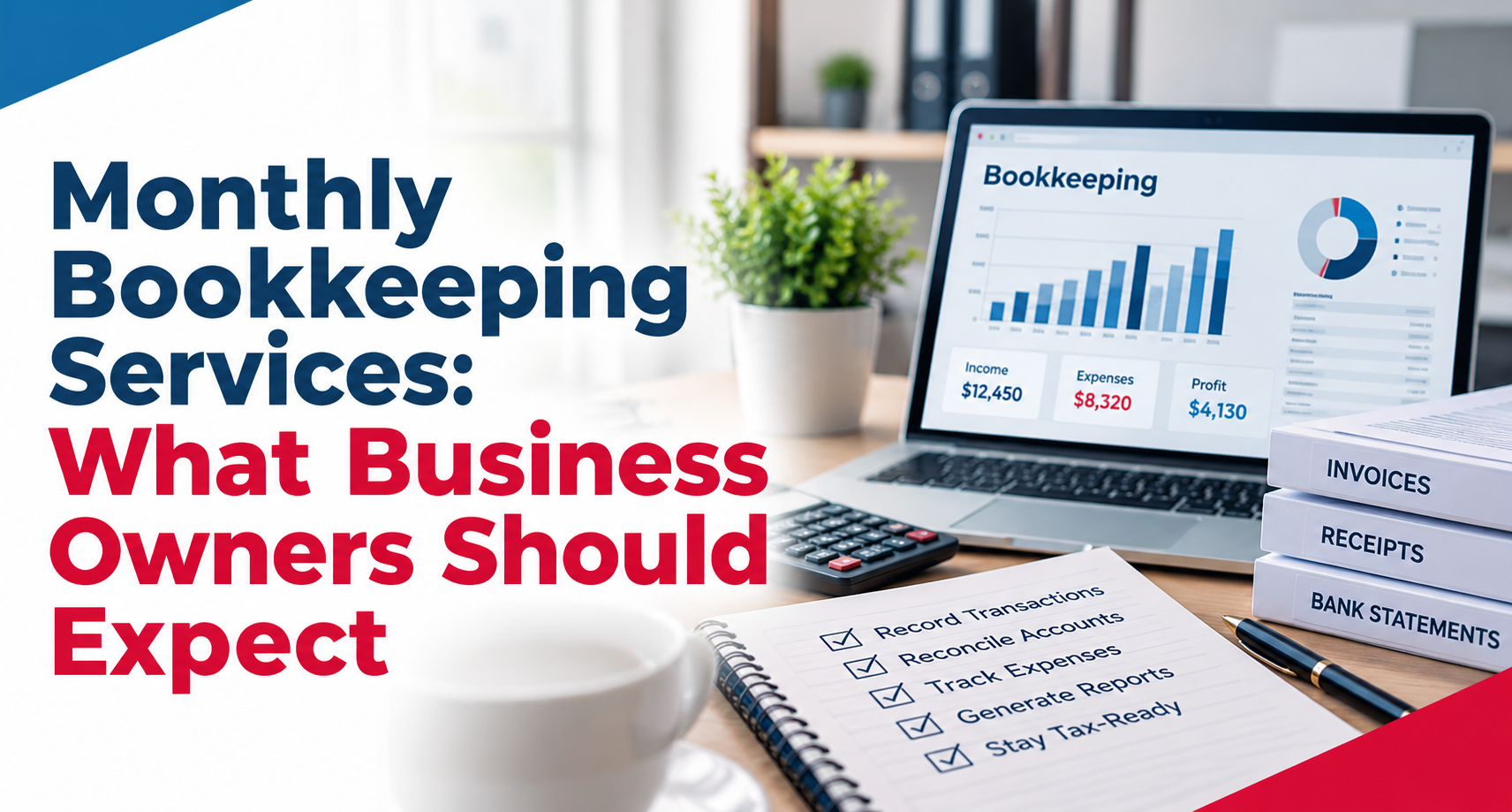
Managing a business involves more than generating sales and serving customers. Business owners must also keep track of income, expenses, invoices, payments, and financial records. Without an organized bookkeeping system, it can become difficult to understand cash flow, monitor profitability, and prepare for tax season.
This is where monthly bookkeeping services can make a difference. By maintaining accurate financial records throughout the year, professional bookkeepers help business owners stay organized, make informed decisions, and spend more time focusing on business growth.
In this guide, we will explore what monthly bookkeeping services typically include, how the process works, what business owners should expect, and how to determine whether outsourcing bookkeeping is the right choice for your business.
What Are Monthly Bookkeeping Services?
Monthly bookkeeping services involve recording, organizing, and reviewing a business's financial transactions on a regular monthly schedule. These services help ensure that financial records remain accurate, current, and useful for business planning.
Depending on the provider and the business's needs, monthly bookkeeping may include recording sales, categorizing expenses, reconciling bank accounts, managing accounts receivable and payable, and preparing financial reports.
Unlike occasional bookkeeping or year-end recordkeeping, a monthly approach helps identify discrepancies and financial trends before they become larger problems.
Monthly bookkeeping is commonly used by small businesses, freelancers, consultants, professional service providers, retailers, and growing companies that need consistent financial oversight.
What Do Monthly Bookkeeping Services Include?
The exact services depend on your business size, transaction volume, and agreement with your bookkeeping provider. However, most monthly bookkeeping packages cover several essential tasks.
1. Recording Income and Expenses
One of the primary responsibilities of a bookkeeper is maintaining an accurate record of business income and expenses.
This includes recording customer payments, sales revenue, operating expenses, supplier payments, software subscriptions, rent, and other business-related transactions.
Transactions are categorized into appropriate accounts within your accounting system. Consistent categorization makes it easier to understand where money comes from and where it goes.
For example, separating marketing expenses from office supplies helps business owners identify which areas consume the most resources.
Accurate transaction records also provide a foundation for financial reporting and tax preparation.
2. Bank and Credit Card Reconciliation
Bank reconciliation involves comparing transactions recorded in your accounting software with those shown on your bank and credit card statements.
This process helps identify missing transactions, duplicate entries, bank fees, unexpected withdrawals, and recording errors.
Regular reconciliation is important because even small discrepancies can create inaccurate financial reports if they remain unresolved.
A monthly bookkeeper typically reviews relevant accounts and investigates differences before finalizing the books for the period.
3. Accounts Receivable Management
Accounts receivable refers to money customers owe your business for products or services already provided.
Monthly bookkeeping may include tracking outstanding invoices, recording customer payments, identifying overdue balances, and preparing accounts receivable reports.
Some bookkeeping providers also offer invoice preparation and payment reminders, although these services may be priced separately.
Keeping track of receivables helps business owners understand how much money is expected to come in and which customers may require follow-up.
4. Accounts Payable Tracking
Accounts payable refers to money your business owes suppliers, contractors, and other vendors.
A bookkeeper may organize vendor bills, record payment obligations, track due dates, and maintain records of payments made.
This information helps business owners plan upcoming expenses and avoid unnecessary late fees.
However, processing payments, approving bills, and managing vendor relationships may fall outside a standard bookkeeping package. Business owners should confirm the exact scope of service before signing an agreement.
5. Monthly Financial Statements
One of the most valuable outcomes of monthly bookkeeping is having financial reports that explain your business's financial position.
Depending on the service agreement, your bookkeeper may prepare the following reports.
Profit and Loss Statement: Shows revenue, expenses, and net profit or loss over a selected period.
Balance Sheet: Summarizes assets, liabilities, and owner's equity at a specific point in time.
Cash Flow Statement: Shows cash inflows and outflows over a period, helping explain how cash moves through the business.
These reports help business owners evaluate performance, monitor expenses, and make better-informed financial decisions.
It is important to understand that profitability and cash availability are not the same. A business can report a profit while experiencing cash flow problems because customers have not yet paid their invoices or significant payments are due.
6. Organizing Financial Documents
Accurate bookkeeping depends on having reliable supporting documentation.
A monthly bookkeeping service may help organize receipts, invoices, bank statements, vendor bills, and other transaction records. Many providers use cloud-based accounting software or secure document-sharing systems to simplify this process.
Well-organized records make it easier to answer financial questions, prepare reports, and provide documentation to a tax professional when needed.
Business owners should ask how documents will be stored, who can access them, and how long records will be retained.
7. Preparing for Tax Season
Monthly bookkeeping helps keep financial information organized throughout the year, reducing the pressure of gathering records at the last minute.
A bookkeeper may categorize potentially deductible expenses, maintain transaction records, and provide reports that a tax preparer can use when preparing business tax returns.
However, bookkeeping is not automatically the same as tax preparation or tax advice. Depending on the provider, filing tax returns, calculating tax liabilities, and advising on tax strategy may require separate services from a qualified tax professional.
Maintaining organized books throughout the year can make the tax preparation process more efficient.
How Does the Monthly Bookkeeping Process Work?
Although every provider has its own workflow, a typical monthly bookkeeping process follows a predictable sequence.
Step 1: Collecting Financial Information
At the beginning of the process, your bookkeeper gathers the necessary records, which may include bank statements, credit card transactions, sales reports, invoices, expense receipts, and payroll summaries.
Some accounting systems allow transactions to be imported automatically, while others require additional documentation from the business owner.
Providing complete and timely information helps prevent delays.
Step 2: Categorizing Transactions
The bookkeeper reviews transactions and assigns them to the appropriate accounts in your accounting system.
Unclear transactions may require clarification from the business owner. This is especially important when personal and business transactions have been mixed or when transaction descriptions are incomplete.
Step 3: Reconciling Accounts
Bank accounts, credit cards, and other relevant financial accounts are reconciled against the accounting records.
Any discrepancies are investigated and corrected when sufficient documentation is available.
Step 4: Reviewing and Finalizing the Books
After transactions have been recorded and accounts reconciled, the bookkeeper reviews the records for unusual balances, missing information, and potential errors.
Some providers also use a month-end checklist or review process to improve consistency.
Step 5: Delivering Reports and Updates
Once the books are ready, the provider shares the agreed financial reports and highlights important questions or issues.
Depending on the engagement, this may happen through email, an accounting dashboard, or a scheduled meeting.
The goal is not simply to record transactions but to give business owners dependable financial information they can use.
What Should Business Owners Expect From a Monthly Bookkeeper?
Hiring a bookkeeping service should provide more than data entry. Business owners should understand what communication, reporting, and support they will receive.
Here are five important expectations to establish before getting started.
1. Clear Service Deliverables
Your agreement should explain which tasks are included in the monthly fee.
Confirm whether the service covers transaction categorization, bank reconciliation, financial statements, accounts receivable tracking, accounts payable, payroll entries, and tax-related record organization.
Clarifying these details helps prevent misunderstandings about what is included and what costs extra.
2. Consistent Monthly Reporting
Your financial reports should arrive according to an agreed schedule. Many providers aim to complete monthly books within the first several weeks of the following month, depending on transaction volume and how quickly documents are supplied.
Ask when your books will typically be closed and when you can expect your reports.
Consistency makes it easier to compare monthly results and identify financial trends.
3. Regular Communication
A good bookkeeping relationship depends on timely communication.
Your bookkeeper should let you know when information is missing, transactions need clarification, or an issue prevents the books from being finalized.
You should also understand how to contact your provider and what response times to expect.
4. Secure Handling of Financial Information
Bookkeeping involves sensitive business and financial data. Ask about secure file sharing, access permissions, data backups, and confidentiality practices.
Use strong passwords and multi-factor authentication where available. Only provide access to the accounts and systems necessary for the agreed work.
Your provider should also explain how financial information will be handled if the engagement ends.
5. Reliable and Understandable Financial Records
Your bookkeeper should maintain records using consistent accounting practices and explain reports in a way you can understand.
While a bookkeeper can identify trends and flag unusual activity, complex questions involving business strategy, tax planning, audits, or financial forecasting may require an accountant or another qualified professional.
Knowing the boundaries of the service helps you build the right support team for your business.
How Much Do Monthly Bookkeeping Services Cost?
The cost of monthly bookkeeping depends on several factors, including transaction volume, business complexity, number of accounts, software requirements, and the level of support provided.
Common pricing models include fixed monthly packages, hourly billing, and customized service agreements.
A simple business with a small number of transactions may need only basic monthly reconciliation and financial reports. A company with multiple bank accounts, inventory, payroll, and complex reporting requirements will generally need more extensive support.
When comparing quotes, look beyond the monthly price. Consider the included services, reporting schedule, experience of the provider, communication standards, and any additional fees.
Ask whether the quoted price includes onboarding, historical cleanup, payroll support, sales tax tracking, and year-end assistance.
The lowest-priced option may not offer the level of accuracy, communication, or reporting your business requires.
In-House Bookkeeping vs. Outsourced Bookkeeping
Business owners often choose between managing bookkeeping internally and hiring an external provider.
In-house bookkeeping offers direct oversight and close coordination with your team. However, it requires time for hiring, training, software, and ongoing management.
Outsourced bookkeeping provides access to an external professional or team without necessarily hiring a full-time employee. It can be useful for businesses that want consistent records but do not have enough work to justify a dedicated in-house bookkeeper.
The right choice depends on your budget, transaction volume, operational needs, and preference for internal control.
Whichever option you choose, establish clear approval procedures for payments, appropriate account permissions, and a process for reviewing financial reports.
Signs Your Business May Need Monthly Bookkeeping Services
You may benefit from professional monthly bookkeeping if:
You frequently fall behind on recording transactions.
You are unsure how much your business actually earns.
You struggle to reconcile bank accounts.
Customer invoices remain unpaid without consistent follow-up.
Tax season becomes stressful because records are incomplete.
You spend too much time managing receipts and financial documents.
You need regular financial reports to support business decisions.
These challenges can make it harder to manage cash flow and plan for future expenses. A consistent bookkeeping process helps bring structure to financial management.
How to Choose the Right Monthly Bookkeeping Service
Before hiring a provider, take time to evaluate their experience, process, and service agreement.
Check relevant experience: Look for experience with businesses similar to yours in size, industry, and accounting complexity.
Ask about accounting software: Confirm whether the provider works with your existing software or can recommend a suitable system.
Understand the reporting process: Ask which reports you will receive, how often they will be delivered, and whether someone will explain the results.
Review security practices: Find out how financial information is protected and who will have access to your accounts.
Confirm pricing and scope: Request a written agreement describing deliverables, deadlines, fees, and services that are excluded.
Ask about communication: Establish how questions will be handled and how quickly you can expect a response.
A dependable bookkeeping provider should be transparent about their process and willing to explain what you can realistically expect.
Frequently Asked Questions
1. Is monthly bookkeeping necessary for a small business?
Monthly bookkeeping is not equally demanding for every business, but regular recordkeeping is valuable even for a small operation. It helps track income and expenses, monitor cash flow, and keep records organized for tax and reporting purposes.
2. How long does monthly bookkeeping take?
The time required depends on transaction volume, business complexity, and the quality of the records provided. A small business with organized transactions may require relatively little work, while a business with multiple accounts or incomplete historical records may need more time.
3. Do I still need an accountant if I hire a bookkeeper?
Possibly. A bookkeeper maintains financial records and prepares routine reports, while an accountant may provide more advanced financial analysis, tax planning, financial statement preparation, or other professional services. Some providers offer both services, but you should confirm their qualifications and scope of work.
4. What documents should I provide each month?
Common documents include bank and credit card statements, sales records, customer invoices, vendor bills, expense receipts, payroll reports, and loan statements. Your provider will give you a list tailored to your business.
5. Can monthly bookkeeping improve cash flow?
It can help you understand cash inflows and outflows, identify overdue customer payments, monitor upcoming obligations, and spot spending patterns. However, bookkeeping alone cannot guarantee positive cash flow; business owners must use the information to make appropriate operating and financial decisions.
6. Can I switch bookkeeping providers?
Yes. Before switching, arrange for the transfer of accounting records, supporting documents, account access, and relevant reconciliations. Confirm that the previous provider has completed the agreed work and that the new provider understands the opening balances and any outstanding issues.
Conclusion
Monthly bookkeeping services help business owners maintain organized financial records, monitor performance, and prepare for important financial obligations. From recording transactions and reconciling accounts to preparing financial statements and organizing tax documentation, consistent bookkeeping provides a clearer view of how a business is performing.
The most suitable service depends on your business's size, transaction volume, reporting needs, and budget. By choosing a provider with clear deliverables, reliable communication, and strong security practices, you can establish a bookkeeping process that supports better financial management.
Ready to simplify your business finances? Evaluate your current bookkeeping process and consider whether professional monthly support could help you save time, improve visibility, and focus more confidently on growing your business.
Disclaimer: This article is for general informational purposes only and does not constitute accounting, tax, or financial advice. Consult a qualified professional for guidance specific to your business and jurisdiction.